The framework in four steps
A value realization framework has four steps: agree on the outcome and take a baseline before anything changes, measure the change in the customer's own units, show the method behind every number, and get the customer to confirm it. Skip the baseline and the other three steps have nothing to stand on.
- Baseline. Before rollout, write down where each goal starts. Hours per week. Errors per thousand. Days to close. Get the number from the customer, and note where it came from.
- Measure. Track the same number, the same way, on a schedule. Quarterly is enough for most accounts.
- Method. For each result, write one line on how you got it. What did you count, over what period, and what did you assume?
- Proof. Put it in front of the customer and ask, "Is this how you'd calculate it?" A number they've corrected is a number they'll repeat to their CFO.
A value template to copy
Value delivered: [Customer name], [period]
| Outcome | Baseline | Now | Change | Worth | How we calculated it |
|---|---|---|---|---|---|
| [Outcome 1, in their words] | [Starting number, and its source] | [Current number] | [Difference] | [Value per year] | [What was counted, the period, the assumptions] |
| [Outcome 2] | [Baseline] | [Now] | [Change] | [Worth] | [Method] |
| [Outcome 3] | [Baseline] | [Now] | [Change] | [Worth] | [Method] |
Total benefit: [sum] · Cost: [what they pay] · ROI: [(benefit − cost) ÷ cost]
What we can't measure yet: [and what it would take]
The ROI formula, with a worked example
The company and numbers below are fictional.
ROI = (benefit − cost) ÷ cost.
A logistics company pays $48,000 a year for a scheduling product. Two outcomes can be measured.
| Outcome | Baseline | Now | How it's valued | Worth per year |
|---|---|---|---|---|
| Dispatch planning time | 11 hours a week per dispatcher | 5.5 hours | 5.5 hours saved × 8 dispatchers × 48 weeks × $38 loaded hourly cost | $80,256 |
| Missed delivery windows | 19 per 1,000 deliveries | 11 per 1,000 | 8 fewer per 1,000 × 60,000 deliveries × $45 average credit | $21,600 |
Total benefit: $101,856. ROI: ($101,856 − $48,000) ÷ $48,000 = 112%.
Now look at what could be challenged. The hourly cost. The number of working weeks. Whether saved hours turned into anything useful. That's fine. Every assumption is on the page, so the customer can change one and the math still holds. A figure with a visible method survives a skeptical finance team. A bigger figure without one doesn't.
What goes on an ROI slide
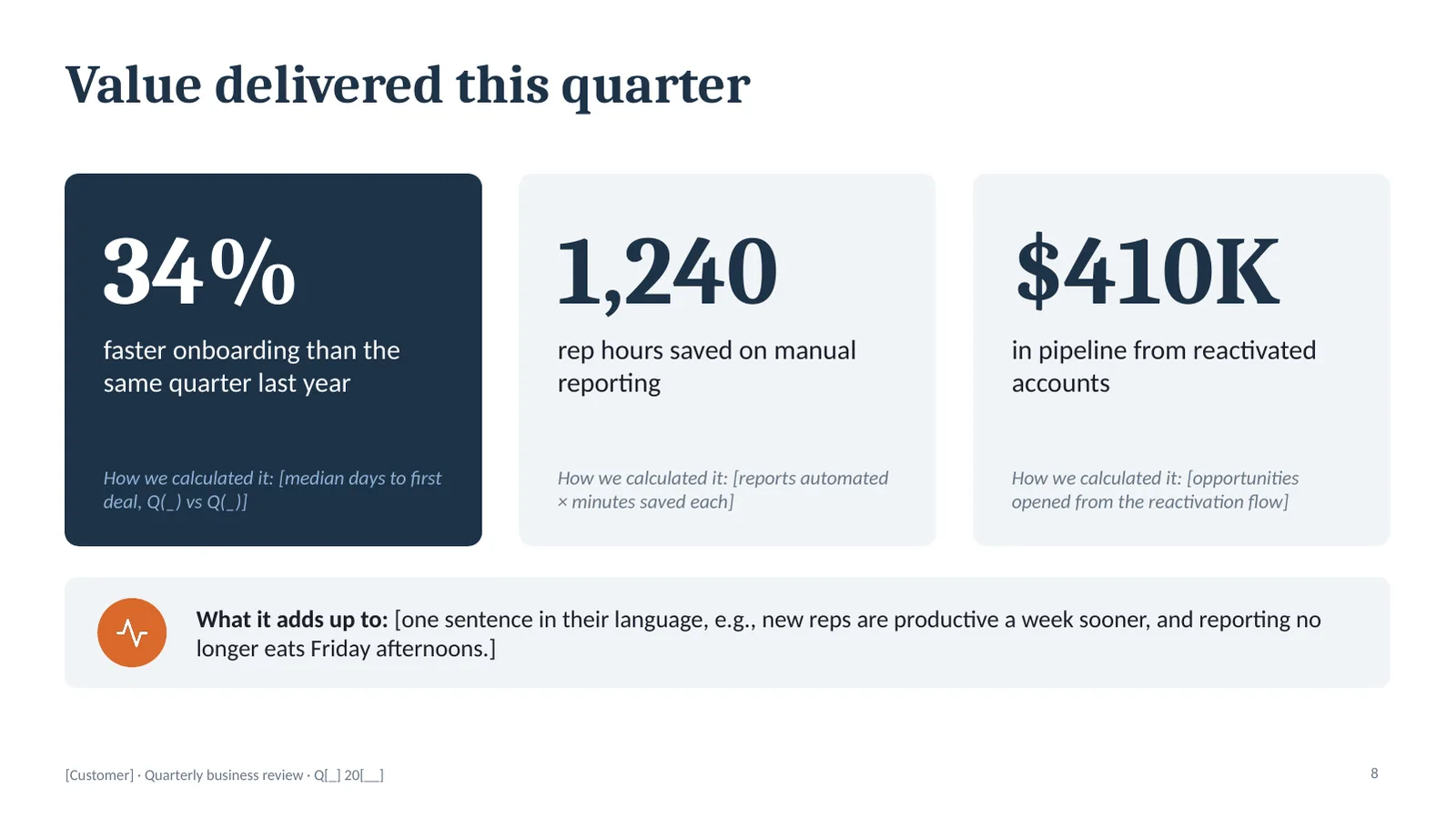
- Three outcomes at most. Time, money or risk, in the customer's units.
- The method under each number. One line. An unexplained number gets discounted to zero.
- The cost. Leaving it off makes the benefit look like marketing.
- One question. "Is this how you'd calculate it?" Then wait.
Where value realization goes wrong
There's no baseline
This is the common one. Nobody measured the starting point, so a year later the team reaches for usage numbers instead. Logins aren't value. They're evidence that value might be happening.
The number is too good
A 900% ROI makes a sponsor suspicious, and they're usually right to be. Use conservative assumptions, say what you left out, and let the customer raise the number if they want to.
It only comes up at renewal
If the first time a customer sees a value figure is alongside a renewal quote, it reads as a sales argument. Show the same table every quarter, in the QBR, and by renewal it's their number too.
The value slide is slide 5
The QBR kit includes the value delivered slide with notes on what to ask and what to avoid, plus the scorecard that feeds it and the 13 slides around them. PowerPoint, opens in Google Slides, $39.
Checkout opens soon. Get the free starter deck now, and the scorecard if you want to hear when the kit is ready.
Value realization questions
What is value realization?
Value realization is the process of measuring and showing the business outcomes a customer has achieved from a product or service, compared with where they started and what they paid. In customer success it runs from the first baseline at kickoff to the value review before renewal.
What is a value realization framework?
A repeatable way to prove value. The one on this page has four steps: agree the outcome and take a baseline, measure the change, show your method, and have the customer confirm the number.
How do you calculate customer ROI?
ROI is the benefit minus the cost, divided by the cost. If a customer pays 40,000 a year and the measured benefit is 100,000, ROI is (100,000 - 40,000) / 40,000, or 150%. The hard part is the benefit figure, which needs a baseline and a method the customer accepts.
What is a business value assessment?
A business value assessment is an estimate, usually made before a sale, of the value a customer could get from a product. Value realization is the after-the-sale counterpart: it checks what the customer got against that estimate.
What should an ROI slide show?
Two or three outcomes in the customer's units, each with its baseline, its current result and one line on how it was calculated. Then the total benefit, the cost and the ROI. Leave off anything you can't explain when asked.
What if I don't have a baseline?
Say so, and rebuild one with the customer: ask what the number was before, from their own records or best estimate, and label it as their estimate. Then start measuring properly from today.