Get the free scorecard
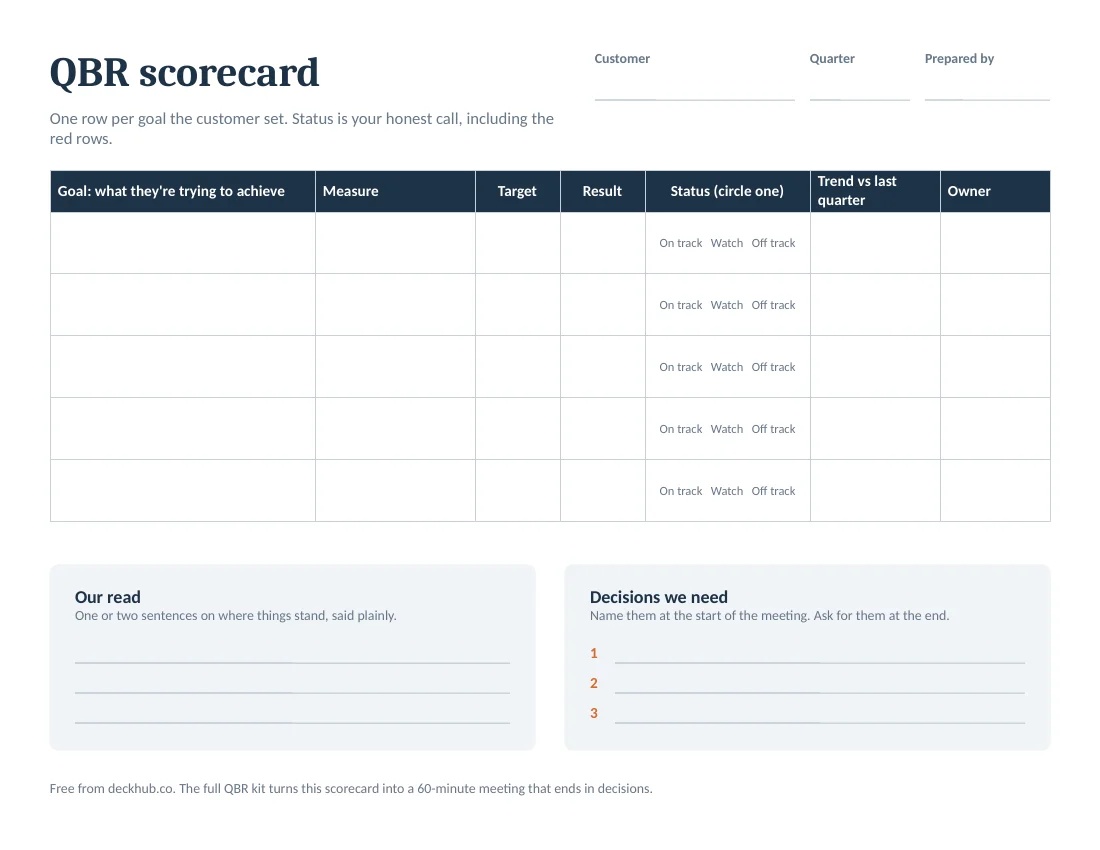
A one-page PDF you can print or fill in before your next QBR: one row per customer goal, an honest status for each, and the decisions you need.
Prefer slides? The scorecard slide is in the free starter deck, no email needed.
What's on the scorecard
A QBR scorecard has one row for each goal the customer set. Each row shows the goal, how it's measured, the target, the result this quarter, the trend, and a status: on track, watch, or off track. Below the rows, list the decisions you need from the meeting.
Here it is as a table you can copy into a doc or a sheet:
| Goal | Measure | Target | Result | Status | Trend |
|---|---|---|---|---|---|
| [Goal in the customer's words] | [How it's measured] | [Target] | [Result] | [On track / Watch / Off track] | [Up or down from last quarter] |
| [Goal 2] | [Measure] | [Target] | [Result] | [Status] | [Trend] |
| [Goal 3] | [Measure] | [Target] | [Result] | [Status] | [Trend] |
| Our read: [One or two sentences. What's on track, what isn't, and what you think is behind it.] | |||||
| Decisions we need: 1. [Decision] 2. [Decision] 3. [Decision] | |||||
How to fill it in
- Write the goals in the customer's words. Pull them from the kickoff notes, the success plan, or the last review. "Cut onboarding time for new reps," not "increase feature adoption."
- Use one measure per goal. The one they'd recognize. If you need three metrics to describe a goal, the goal isn't clear yet.
- State the target they agreed to. If there was never a target, write "not set" and make setting it a decision for the meeting.
- Put the real result in. Not the best week. Not a number with an asterisk.
- Set the status last. And set it honestly.
How to set the status
| Status | Use it when | What you say in the room |
|---|---|---|
| On track | The result meets the target, or will at the current pace | "This one's working. Here's why we think so." |
| Watch | Close to target but moving the wrong way, or on target for a reason you don't trust | "This is close, and here's what worries us." |
| Off track | The result misses the target and won't recover without a change | "This isn't working. Here's our read on the cause." |
The pull toward green is strong. Resist it.
A sponsor who sees three green rows and then hears about problems from their own team stops believing your scorecards. A sponsor who hears you name the red row first starts trusting the green ones.
The scorecard is the start of the conversation
A scorecard tells you what happened. It can't tell you why. That's the next slide's job, and the reason the meeting exists.
So don't spend 30 minutes walking the rows. Send the scorecard a week ahead as a pre-read, take questions on it for ten minutes, and give the time you saved to the diagnosis. The QBR agenda shows how the hour breaks down, and the worked examples show three scorecards filled in.
Turn the scorecard into the whole meeting
The QBR kit builds the meeting around this scorecard: 15 slides in order, notes on every slide, a prep timeline and a 60-minute run-of-show. PowerPoint, opens in Google Slides, $39.
Checkout opens soon. Get the free starter deck now, and the scorecard if you want to hear when the kit is ready.
QBR scorecard questions
What is a QBR scorecard?
A QBR scorecard is a one-page summary of a customer's goals and results for the quarter. Each row has the goal, how it's measured, the target, the result, the trend and a status of on track, watch or off track.
What metrics go on a QBR scorecard?
The customer's metrics, not yours. Use the measures they agreed to when they set their goals: time saved, cost reduced, revenue influenced, errors avoided. Product usage belongs on the scorecard only when adoption is itself one of their goals.
How many goals should a scorecard have?
Three is ideal and five is the limit. Past that, nobody can hold the picture in their head and the meeting turns into a line-by-line read.
What if we never agreed on goals with the customer?
Then that's the first item for your next review. Bring a draft of what you believe their goals are, ask them to correct it, and write the agreed version down. A success plan is the place to keep it.