The template
A mutual action plan has one row per action, and every row answers five questions: what's the action, who owns it, which side are they on, when is it due, and what does "done" mean. Above the rows, write the outcome the plan is for.
Mutual action plan: [Customer name] and [Your company]
The outcome this plan is for: [One sentence. The goal, the target and the date.]
Last updated: [date] · Next check: [date]
| Action | Owner | Side | Due | Done when | Status |
|---|---|---|---|---|---|
| [Action] | [Name] | [Us / You] | [Date] | [What you'll be able to see] | [Not started / On track / Late / Done] |
| [Action] | [Name] | [Us / You] | [Date] | [Done when] | [Status] |
| [Action] | [Name] | [Us / You] | [Date] | [Done when] | [Status] |
| [Action] | [Name] | [Us / You] | [Date] | [Done when] | [Status] |
Open decisions: [Decision] · Who decides: [name] · By: [date]
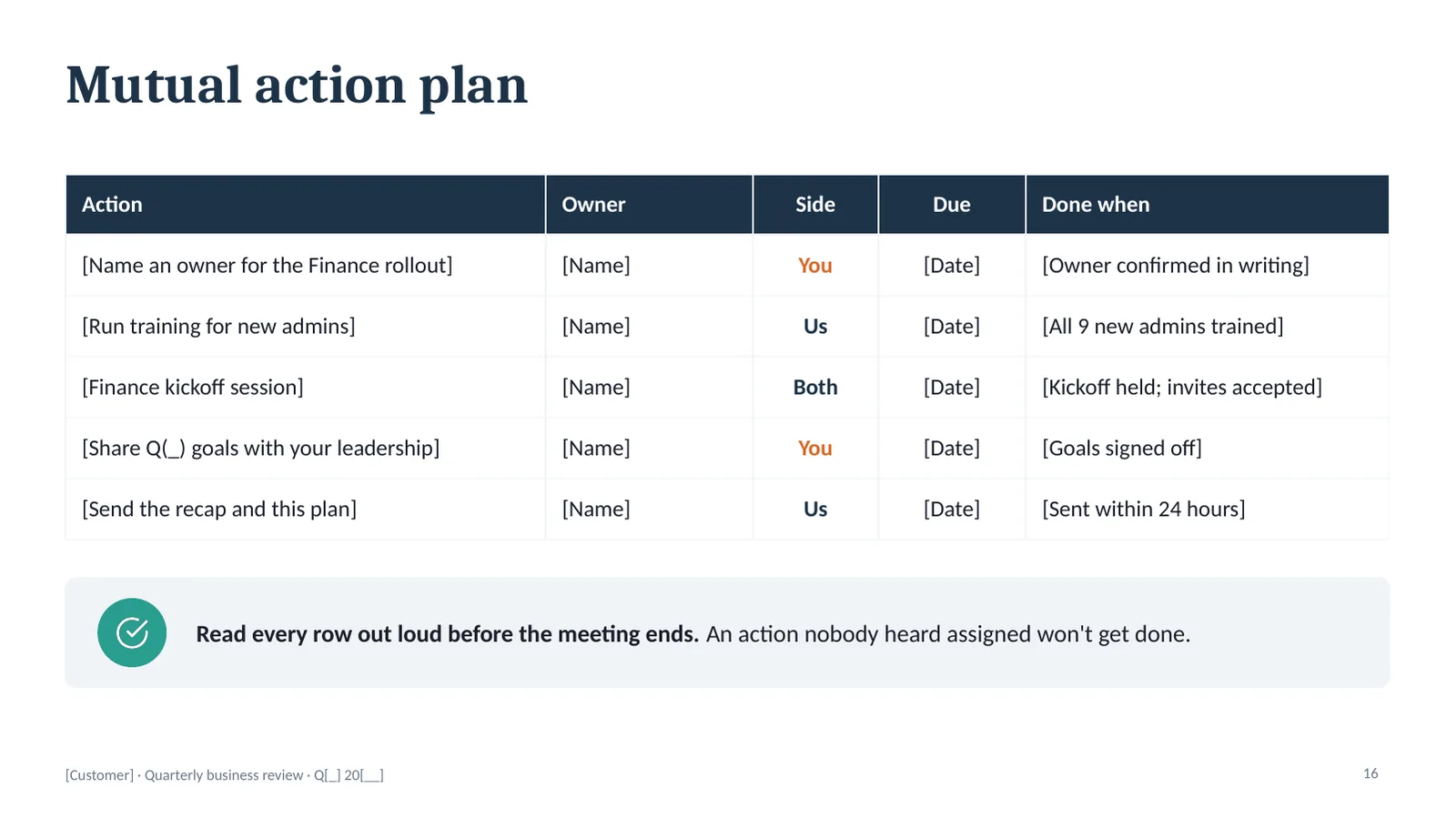
A completed example
The account, names and dates below are fictional.
The outcome this plan is for: weekly active reps back above 70% by the end of the quarter.
| Action | Owner | Side | Due | Done when |
|---|---|---|---|---|
| Name an interim product owner | VP of Sales | You | Oct 10 | The owner is announced to the sales managers |
| Train the interim owner as admin | Customer success manager | Us | Oct 17 | They've changed a territory setting without help |
| Patch onboarding for the new territories | Onboarding lead | Us | Oct 24 | The November hiring class starts on the new path |
| Run the forecast call from the pipeline report | All 9 sales managers | You | Nov 7 | Two forecast calls in a row with no spreadsheet |
| Review weekly active reps together | Interim owner and CSM | Both | Monthly | The number is sent to the VP after each review |
This plan comes out of the at-risk account in the QBR examples. Notice the first row. The most important action on the plan belongs to the customer, and it's small enough to agree to in the room.
Five rules that keep a plan alive
- One named owner per row. A person. "The ops team" doesn't own anything, and neither does "TBD."
- Both sides have rows. If the customer owns nothing, they've agreed to watch you work.
- "Done when" is something you can see. "Improve training" can't be finished. "Every new admin has changed a setting without help" can.
- Fill it in live. Type the rows on screen, during the meeting, and read each one out loud before anyone leaves. An action nobody heard assigned won't get done.
- Open the next meeting with it. Start every monthly review from the late rows. The plan stays alive because someone keeps asking.
Where the actions should come from
Here's where most action plans go wrong, and it happens before anyone writes a row.
The team sees a symptom and assigns a fix. Adoption is down, so the action is "run more training." Everyone nods. Six weeks later the training is done and adoption hasn't moved, because training was never the problem. Nobody owned the product on the customer's side.
An action plan is only as good as the read of the cause behind it. So before you fill in the table, agree on what's causing the problem. That's the job of the diagnosis slide, and it's why the action plan comes after it in the QBR deck.
In sales and after the sale
The mutual action plan started as a sales document: the steps from "we're interested" to a signed contract, with dates the buyer has agreed to. Security review. Legal. Procurement. The pilot.
The same table works after the sale, and it matters more there. A deal has a natural deadline. A customer relationship doesn't, so without a plan with dates, "next quarter" quietly becomes next year. Keep the format and change the outcome at the top, from "signed by" to "live by" or "back on track by."
The action plan is slide 13
The QBR kit includes the mutual action plan slide, with notes on how to fill it in live, plus the 14 slides that earn it: goals, scorecard, diagnosis and decisions. The free starter deck includes the action plan slide too. PowerPoint, opens in Google Slides, $39.
Checkout opens soon. Get the free starter deck now, and the scorecard if you want to hear when the kit is ready.
Mutual action plan questions
What is a mutual action plan?
A mutual action plan (MAP) is a shared list of the actions a vendor and a customer have each committed to, with a named owner, a due date and a definition of done for every action. Sales teams use one to get a deal to signature. Customer success and account teams use one to get from a review meeting to results.
What should a mutual action plan include?
The outcome the plan is for, then one row per action: the action, a named owner, which side owns it, the due date, what done means, and the current status. Add a short list of open decisions with who decides and by when.
What's the difference between a mutual action plan and a mutual success plan?
People use the names interchangeably. Where teams draw a line, the mutual success plan is the longer-lived document with goals and measures, and the mutual action plan is the list of near-term actions under it.
Who owns the mutual action plan?
One person keeps the document current, usually the account manager or customer success manager. But the plan is only mutual if the customer has owners on it too. If every row is yours, it's a to-do list.
How many actions should a mutual action plan have?
Five to eight for a quarter. More than ten and the plan stops being read.
How often should you review a mutual action plan?
At least monthly, and at every quarterly review. A plan that's only opened once a quarter is a record of what didn't happen.