The deck at a glance
| # | Slide | Its job | If you're short on time |
|---|---|---|---|
| 1 | Cover | Say whose meeting this is | Keep |
| 2 | Today | Name the decisions you need | Keep |
| 3 | Their goals | Confirm what you're measuring against | Merge into the scorecard |
| 4 | Scorecard | Show where each goal stands | Keep |
| 5 | Value delivered | Put outcomes in their numbers | Shorten to one figure |
| 6 | Adoption | Explain the scorecard | Appendix |
| 7 | What's working | Bank the wins, with evidence | One line on the scorecard |
| 8 | What isn't working, and why | Agree on the cause | Never cut |
| 9 | Support and account health | Surface renewal signals | Appendix |
| 10 | Risks and open issues | Give every risk an owner | Fold into the action plan |
| 11 | Next quarter | Set the next scorecard | Keep |
| 12 | Roadmap | Connect what's coming to their goals | Cut first |
| 13 | Mutual action plan | Owners, dates, done-when | Keep |
| 14 | Decisions | Ask, and wait | Never cut |
1. Cover
The customer's name goes first. Put the executive sponsor's name on the "prepared for" line. It's a small signal, and they notice: this was built for them, not exported from a dashboard.
2. Today: what we need to decide
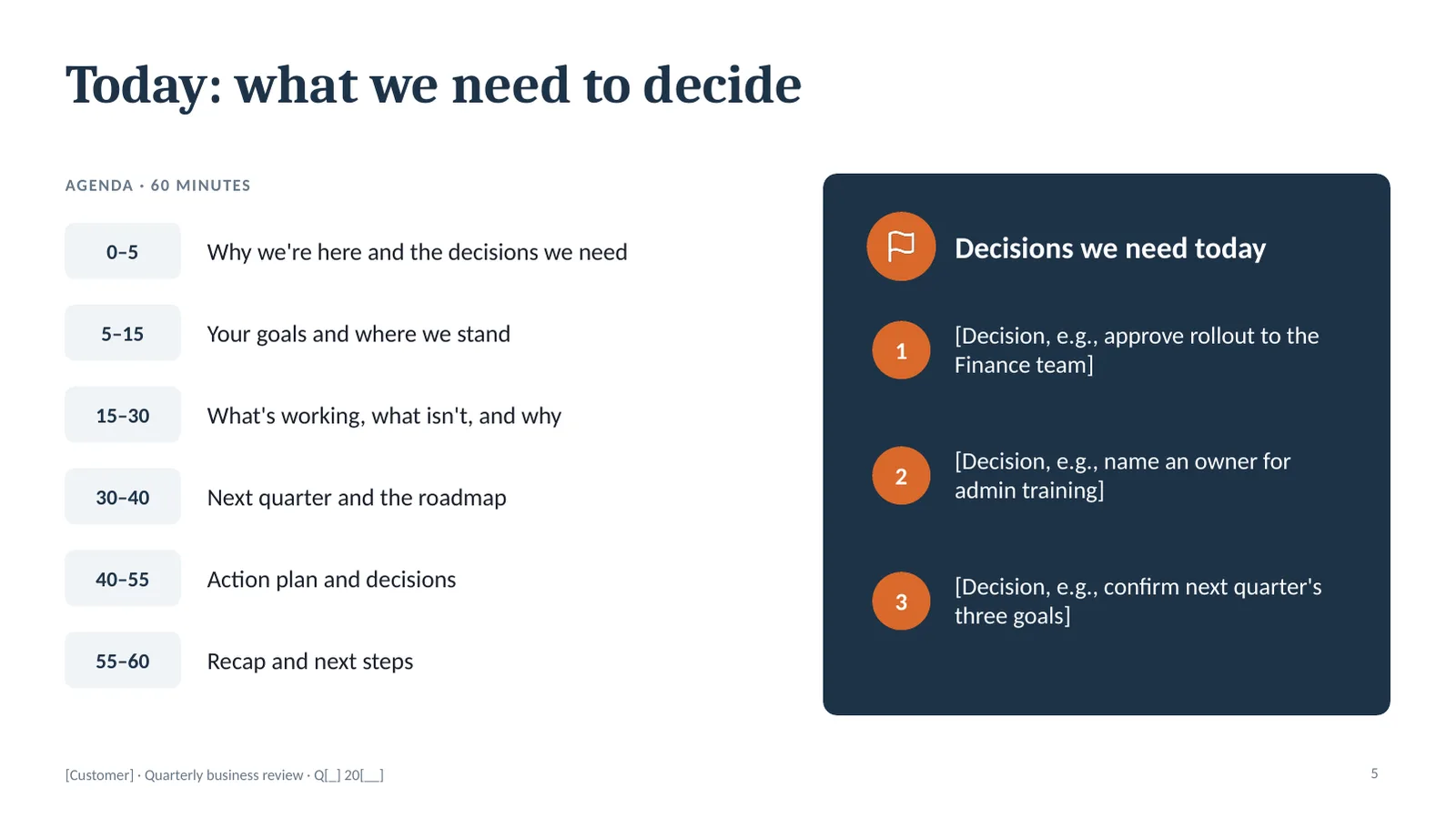
Most agenda slides list topics. This one also lists the two or three decisions you need by the end of the hour. Say them out loud in the first five minutes.
Ask: "Is there anything you need decided today that isn't on this list?"
Avoid: saving the ask for the last slide. If the sponsor hears it for the first time at minute 55, the answer is "let us think about it."
3. Their goals
What the customer told you they're trying to achieve, in their words, with how each goal is measured and who owns it on their side. Three goals at most.
Ask: "Are these still the right goals?" Then wait. Priorities shift in a quarter. Better to find out on slide three than after you've scored the wrong things.
4. Scorecard
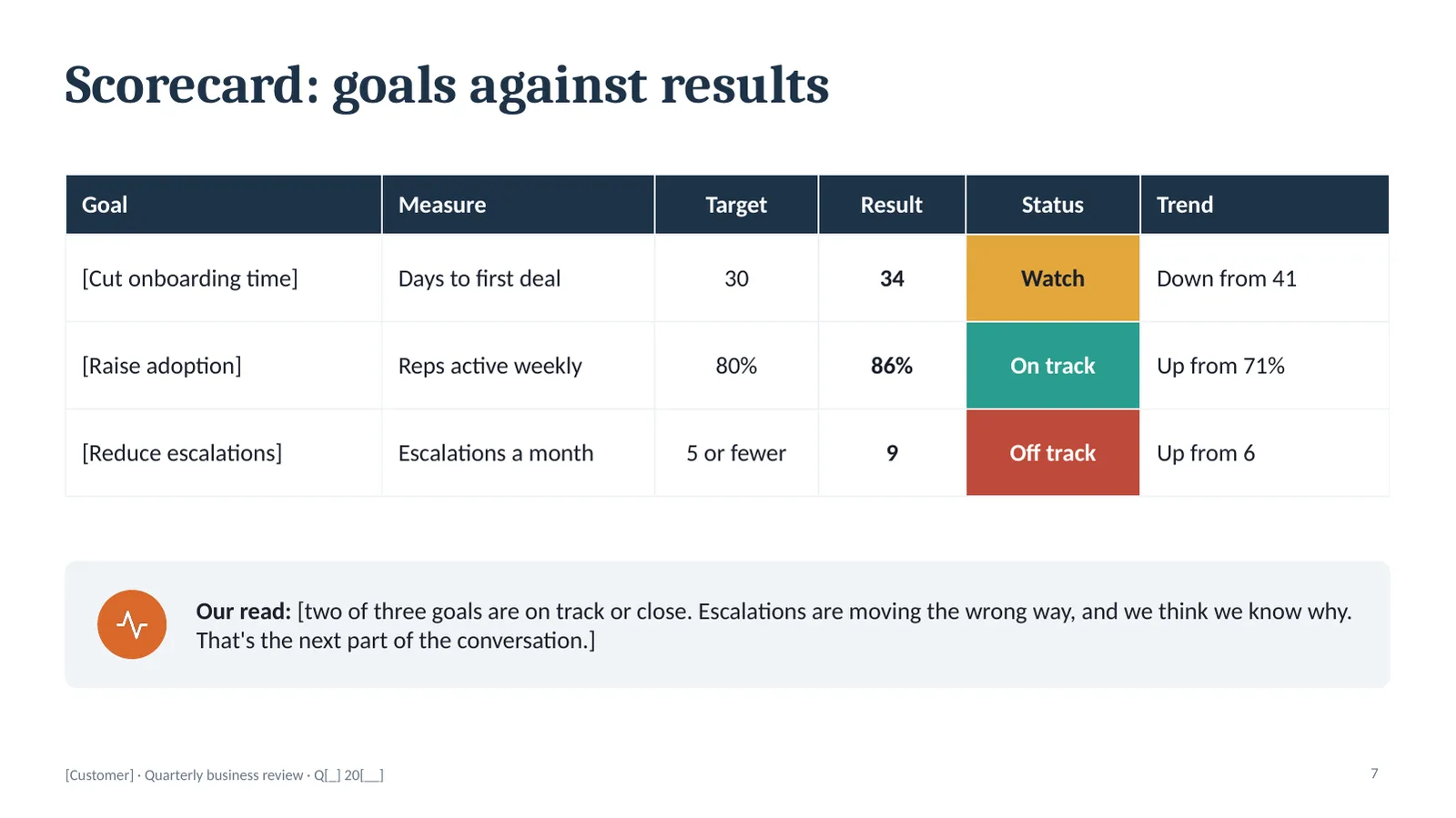
One row per goal: target, result, trend, and a status. Be honest with the status. If a row is red, say so before they do.
Avoid: a wall of green. A scorecard that's all green either has soft targets or a presenter who isn't telling the truth, and the sponsor can't tell which.
5. Value delivered
Three outcomes at most, in the customer's language: time saved, money made or saved, risk reduced. Under each figure, show how you calculated it. An unexplained number gets discounted to zero.
If your data is imperfect, say what you assumed. A modest number with a visible method beats a big one nobody believes.
6. Adoption
Not every usage chart you have. The one cut that explains the scorecard, usually by team or role.
Ask about the bottom of the chart, not the top. The team at 14% is where next quarter's result is hiding.
7. What's working
Two or three things, each with one piece of evidence. If your champion will let you quote them, do. A sentence from their own colleague lands harder than any chart of yours.
8. What isn't working, and why we think so
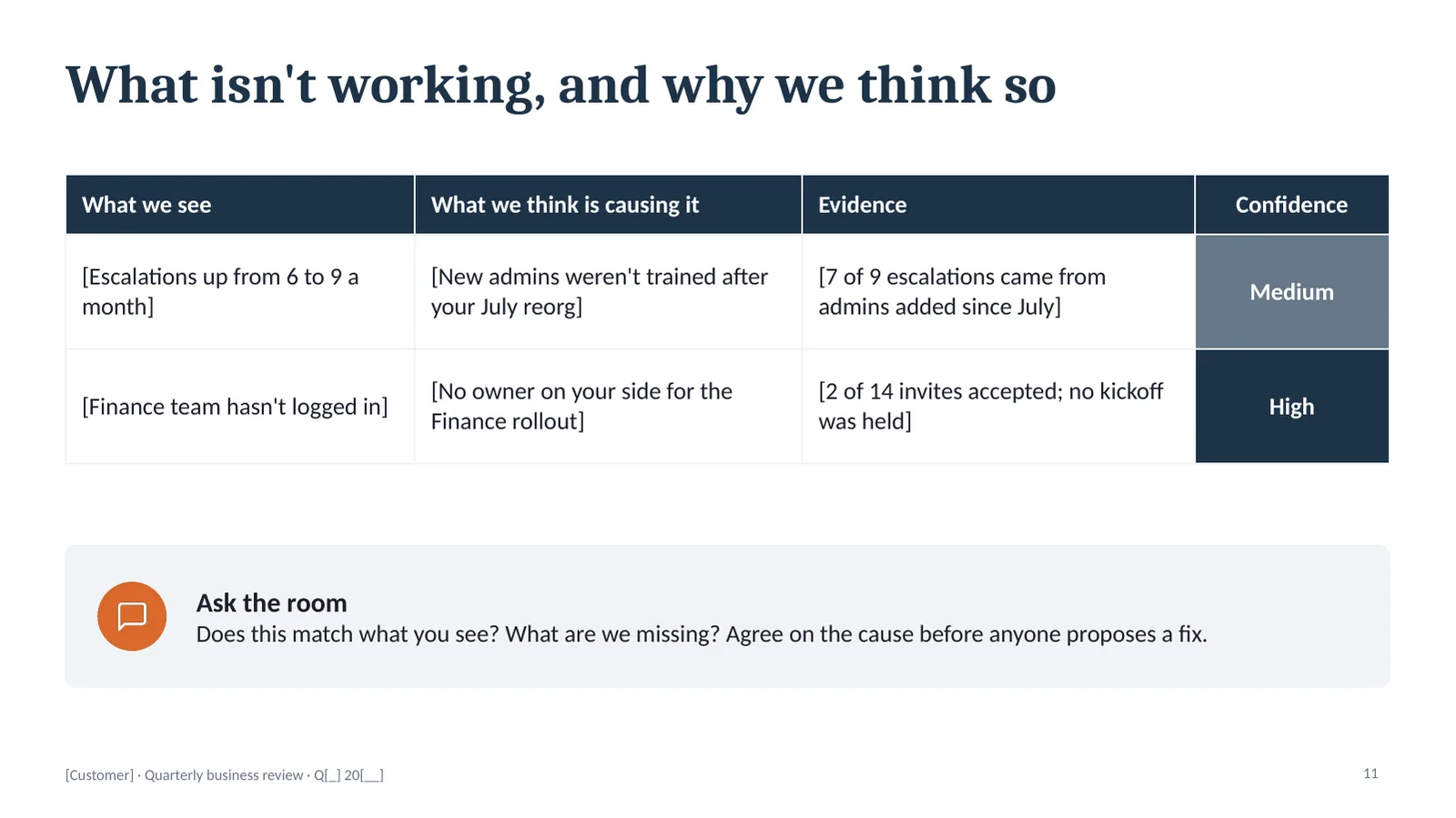
This is the slide most decks skip, and the reason the rest of the deck exists.
Four columns. What we see is the symptom. What we think is causing it is your diagnosis. Evidence is why you believe it. Confidence is how sure you are.
Ask: "Does this match what you see? What are we missing?" Then stop talking.
Rate your confidence honestly. "Medium" invites the customer to fill in what you don't know, and their correction is the most useful thing you'll hear all hour. Agree on the cause before anyone proposes a fix. Otherwise the action plan treats symptoms.
9. Support and account health
The support trend, plus the signals that predict renewal: sponsor engagement, renewal date, the last survey score. Keep it to what changed and what it means.
10. Risks and open issues
Risks to their goals or to the relationship. Each one gets an owner, on your side or theirs, and a date. A risk with no owner is a surprise waiting for the renewal call.
11. Next quarter
No more than three goals, each with one measure and one target. Write them in the room if you can. These become next quarter's scorecard, which is what turns a one-off meeting into a rhythm.
12. Roadmap
Only what touches their goals, with a line on why each item matters to them. Say plainly what's dated and what isn't. If you're running short, this is the slide to skip. Nobody ever renewed because of a roadmap slide they half-watched.
13. Mutual action plan
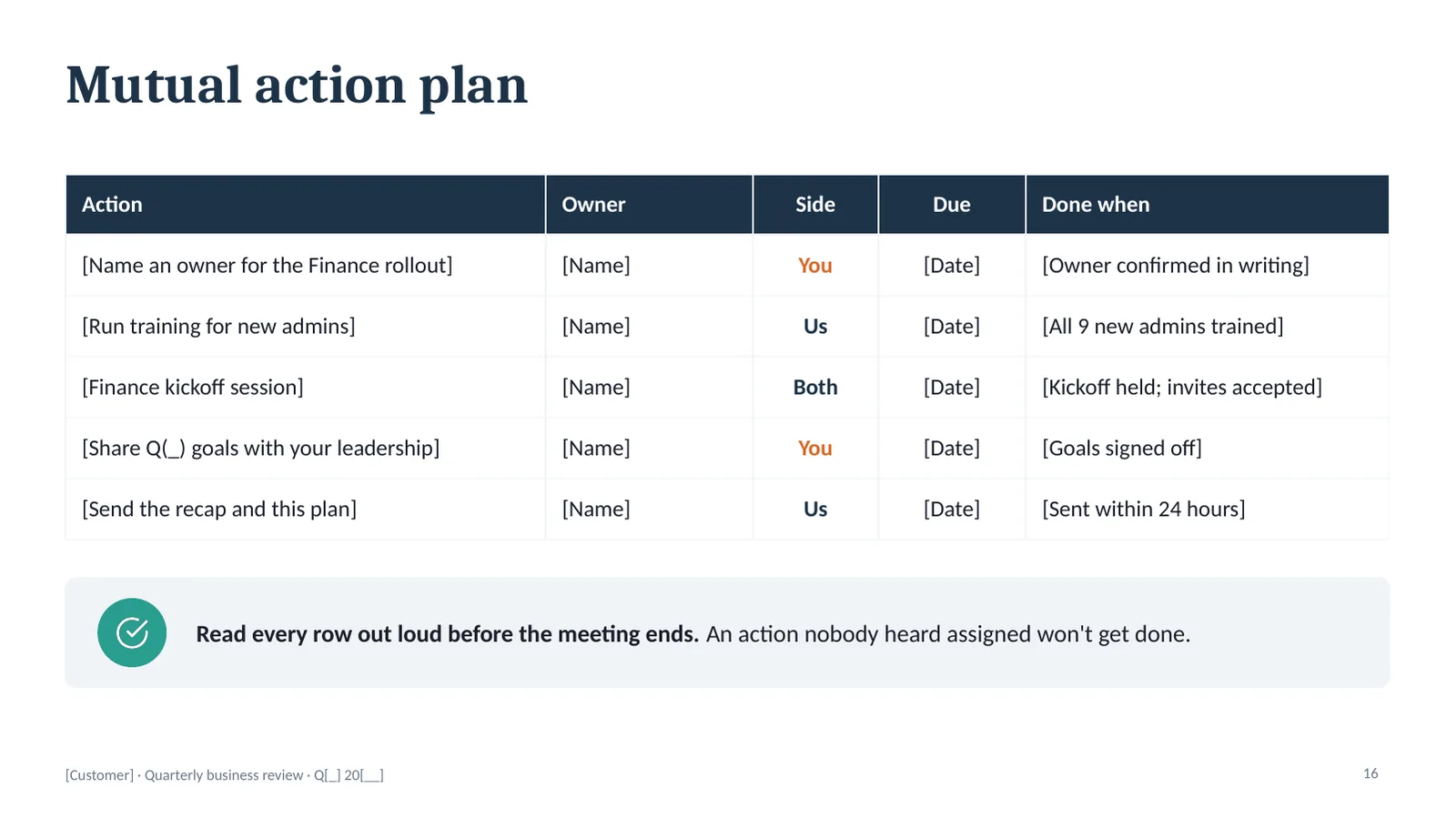
Every action, a named owner, which side owns it, a date, and what "done" means. Fill it in during the meeting, on screen. An action nobody heard assigned won't get done. There's more on this in the mutual action plan template.
14. Decisions
The same decisions from slide two, each with the options and your recommendation.
Ask for each one directly. Then wait. Silence is fine.
Avoid leaving with "we'll think about it." If they can't decide today, ask who can and by when, and put that in the action plan.
The appendix
Monthly numbers, extra charts, anything someone asked for that didn't earn a main slide. Its real job is to protect the hour: "Good question. The detail's in the appendix. Let's look after the decisions."
The six-slide version
Thirty minutes? Keep these: today, scorecard, what isn't working and why, next quarter, action plan, decisions. Everything else goes in the pre-read.
Get the QBR kit
Fifteen slides in meeting order, with notes on every slide: what goes there, what to ask and what to avoid. It also includes AI prompts that draft the deck from your notes, the prep timeline and a 60-minute run-of-show. PowerPoint, opens in Google Slides, $39.
Checkout opens soon. Get the free starter deck now, and the scorecard if you want to hear when the kit is ready.
QBR deck questions
What should be included in a QBR deck?
The customer's goals, a scorecard of results against them, value delivered, what's working, what isn't working and why, account health, risks, next quarter's goals, a roadmap limited to what affects those goals, a mutual action plan and the decisions you need.
How many slides should a QBR presentation have?
About fourteen for 60 minutes, plus an appendix. For a 30-minute review, six: agenda and decisions, scorecard, diagnosis, next quarter, action plan, decisions.
What's the most important slide in a QBR deck?
The diagnosis: what isn't working and what you think is causing it. It's the conversation only this meeting can have, and it decides whether the action plan fixes causes or treats symptoms.
Should a QBR deck include a product roadmap?
Only the parts that touch the customer's goals. It's also the first thing to cut when time runs short.