Why the hard QBR goes wrong
Here's the usual version. The account team knows the numbers are bad. So the deck opens with the one metric that went up. The problems arrive on slide nine, in gray text, under the heading "areas of opportunity."
The sponsor has already heard what's wrong from their own team. They sit through eight slides waiting to see whether you'll say it. When you don't, they learn something worse than the bad result: either you don't know, or you won't tell them.
An unhappy customer rarely leaves over one bad quarter. They leave because they stop believing you see what they see.
Before the meeting
- Call your champion. Ask what's being said internally, who's most frustrated, and what the sponsor expects to hear. Don't defend anything on this call. Take notes.
- Find out what you got wrong. There's almost always something: a missed handoff, a slow fix, a promise from the sales process that nobody kept. Know it before they raise it.
- Separate symptoms from causes. "Usage is down" is what you see. Why is it down? Write your read of the cause, the evidence, and how sure you are. If you don't know, write that.
- Decide what you'll ask for. One or two decisions, small enough to make in the room.
- Tell them what's coming. Send a short note so nobody walks in braced for a sales pitch.
The email to send first
Subject: Our review on [date]: what isn't working, and what we'd like to decide
Hi [name],
I want to be direct ahead of our review on [date]. [The result] is well short of the [target] we agreed, and I'd like to spend the meeting on that instead of a general update.
Here's our current read of why: [one or two sentences, including the part that's ours]. We may have this wrong, and I'd like to hear what you're seeing.
By the end of the meeting, I'd like us to decide:
1. [Decision]
2. [Decision]
I've kept it to 45 minutes. If there's someone else who should be in the room, tell me and I'll add them.
[Your name]
A 45-minute agenda for a hard QBR
| Minutes | Block | Who talks most | Done when |
|---|---|---|---|
| 0–5 | Say the hard thing, and name the decisions | You | They've heard you say what isn't working |
| 5–15 | What they're seeing | The customer | They've said everything they came to say |
| 15–30 | The cause: our read, and their correction | Both | You agree on the cause, including which part is whose |
| 30–40 | Decisions and the next 60 days | Both | Each action has an owner and a date |
| 40–45 | Recap, and the date you'll check in | You | The next review is on the calendar |
No roadmap. No value slide. No wins, unless the customer brings one up. You can cover those next quarter, if there is one.
The first five minutes
Open with the red row. Something like this:
"Before anything else: we agreed on 80% of reps active each week, and we're at 52%, down from 71%. That isn't working, and I don't want to spend this hour pretending otherwise. I'd like to use the time to agree on why, and decide two things before we leave."
Then stop, and let them respond.
It feels exposed. It's also the fastest way to change the temperature of the room. The sponsor came in ready to push past your spin, and now there isn't any to push past.
Then let them talk
The second block is theirs. Ask, "What are you seeing?" and take notes where they can see you taking them. Don't explain. Don't correct the details, even the ones that are wrong. You'll get to causes in a minute, and a customer who hasn't finished talking isn't ready to hear yours.
When they stop, ask, "What else?" The thing that's really bothering them is often the second or third thing they say.
Agree on the cause before you offer a fix
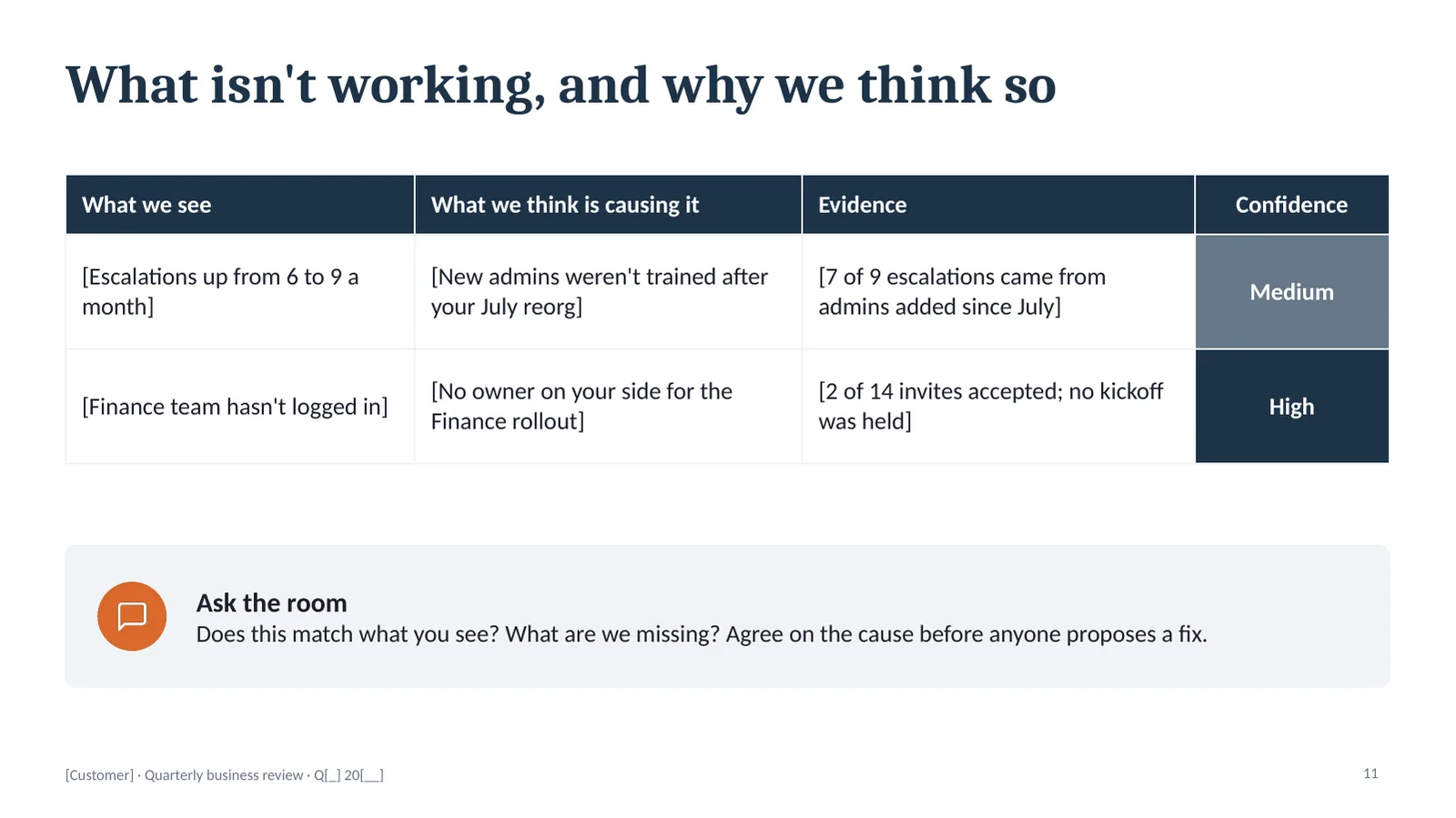
Under pressure, teams skip straight to remedies. More training. A discount. A new point of contact. Each one sounds responsive, and each one is a guess if you haven't agreed on what's wrong.
Put your read on one slide in four columns: what we see, what we think is causing it, the evidence, and your confidence. Include the causes on your side. Then ask, "Does this match what you see? What are we missing?"
Two things to hold onto here.
Own your part first. "We handed you off to support after onboarding and nobody followed up for two months" costs you less than you think. It also earns you the right to say the next sentence.
Name their part without blame. "Since your sales ops lead left in April, nobody has owned the product on your side, and the drop starts that month." That's an observation with evidence. Said that way, most sponsors nod.
The at-risk account in the QBR examples shows this slide filled in, including a row that says "we don't know yet."
Ask for small decisions
An unhappy customer won't commit to a year. They'll commit to a next step. So ask for one or two decisions that can be made in the room and tested within 60 days: an interim owner, a patch before a rebuild, one goal instead of three.
Write them into a mutual action plan on screen, with owners on both sides. Then put the next check-in on the calendar before anyone leaves. Thirty days, not ninety.
If they say they're thinking of leaving
Don't argue, and don't reach for a discount. Ask one question: "What would you need to see in the next 60 days to feel differently?"
Write down exactly what they say. Read it back. That's now the scorecard. A customer who has told you their conditions has, whether they meant to or not, told you how to keep them.
And if the answer is "nothing," you've learned that today instead of on the renewal call. That's worth knowing too.
After the meeting
Send the recap the same day: what you both agreed is causing the problem, the decisions, the actions with owners and dates, and when you'll meet next. Then do your first action early. In a recovery, the first kept promise is what the customer is watching for.
Get the QBR kit
Fifteen slides in meeting order, with notes on every slide: what goes there, what to ask and what to avoid. It also includes AI prompts that draft the deck from your notes, the prep timeline and a 60-minute run-of-show. PowerPoint, opens in Google Slides, $39.
Checkout opens soon. Get the free starter deck now, and the scorecard if you want to hear when the kit is ready.
Questions about hard QBRs
Should you cancel a QBR if the customer is unhappy?
No. Postponing tells the customer you're avoiding the problem. Hold the meeting, shorten it, and spend it on the problem. If the person who can make decisions can't attend, move it by days, not by a quarter.
How do you present bad results in a QBR?
Say them first and plainly. Show the result against the target, mark it off track, give your read of the cause with the evidence and how confident you are, and ask whether that matches what the customer sees. Then bring a specific decision that addresses the cause.
What if the problem is on the customer's side?
Say so, with evidence, and without blame. Describe what you see and what you think is behind it, name the part that's yours, and ask what you're missing. Customers accept a cause on their side far more readily when you've owned yours first.
What if the customer wants to talk about canceling?
Let them. Ask what would have to be true for them to stay, and write it down as the goal for the next 60 to 90 days. A customer who names their conditions has given you a plan.
Who should be in a recovery QBR?
The customer's executive sponsor and the person closest to the problem. On your side, the account owner and someone with the authority to commit resources. Keep it small.