The short version
To present bad results in a QBR, do four things in order: say the result first, show it against the target with an honest status, give your read of the cause with evidence and a confidence level, and bring a decision that addresses the cause. Then ask whether your read matches what the customer sees.
Why softening backfires
The sponsor almost always knows. Their own team has told them, or they've felt it. So they aren't listening to find out what happened. They're listening to find out whether you know, and whether you'll say it.
Lead with the one green metric, tuck the miss into slide nine, call it an "area of opportunity," and you've answered that question badly. From then on, every good number you show gets the same doubt.
Say it first, and the opposite happens. The sponsor relaxes. Now your green rows mean something.
Before and after
The difference is mostly in the wording. Here are five lines the way they usually get written, and the way they should be.
| Where | The soft version | The straight version |
|---|---|---|
| Opening | "Lots of great progress to share today." | "Two of your three goals are off track. I'd like to spend most of today on why." |
| Scorecard status | "In progress" | "Off track" |
| The number | "Adoption continues to grow in key teams." | "52% of reps are active each week. The target is 80%. Last quarter it was 71%." |
| The cause | "Some change-management challenges." | "Nobody has owned the product on your side since April. The drop starts that month." |
| The ask | "We'd love to partner more closely." | "We need you to name an interim owner this week. Can we decide that today?" |
Read the left column again. Nothing in it is false. It's just built so that nobody has to feel anything. The sponsor notices.
The four moves
1. Say it first
In the first five minutes, before any slide that makes you look good. Name the miss and say you'd like to spend the time on it.
2. Show the number against the target
Target, result, trend, status. No adjectives. If the row is red on the scorecard, mark it red. A sponsor who sees you mark your own work down will believe the rows you mark up.
3. Give your read of the cause
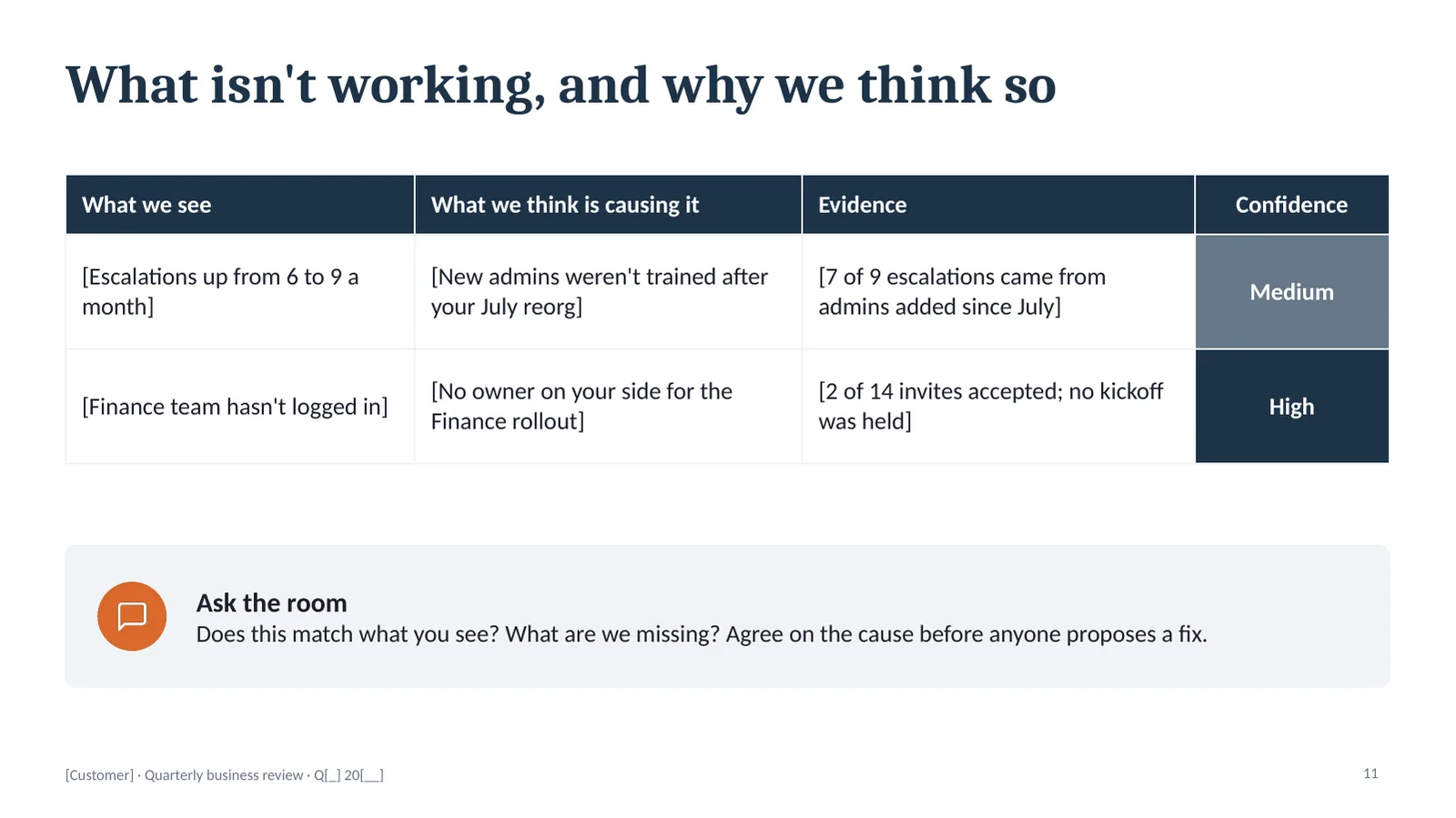
A bad number with no explanation is alarming. A bad number with a believable cause is a problem to solve. Put your read on one slide: what you see, what you think is causing it, the evidence, and how confident you are. Include the causes on your side.
Then ask, "Does this match what you see?" and stop talking. Their correction is worth more than your slide.
4. Bring a decision
Don't end on the problem. Bring one or two decisions that address the cause, each with options and your recommendation, sized so they can be made in the room.
Three things to avoid
- Only external causes. If every reason is the market, the reorg or the customer's team, the sponsor hears excuses. Find your part and say it first.
- A fix with no diagnosis. "We'll run more training" sounds responsive. If training wasn't the problem, you've spent a quarter and some credibility.
- The surprise. Tell your champion what you'll present before the meeting. Nobody on their side should hear a red number for the first time in front of their boss.
When the account is in real trouble
If the relationship itself is at risk, shorten the meeting and build the whole thing around the problem. There's a 45-minute agenda and an email to send first in how to run a QBR when the customer is unhappy. For a filled-in version of the slides, see the at-risk account in the QBR examples.
Get the QBR kit
Fifteen slides in meeting order, with notes on every slide: what goes there, what to ask and what to avoid. It also includes AI prompts that draft the deck from your notes, the prep timeline and a 60-minute run-of-show. PowerPoint, opens in Google Slides, $39.
Checkout opens soon. Get the free starter deck now, and the scorecard if you want to hear when the kit is ready.
Questions about bad results
How do you present bad results in a QBR?
Say them in the first five minutes. Show the result against the target with an honest status, give your read of the cause with the evidence and how confident you are, ask whether that matches what the customer sees, and bring a specific decision that addresses the cause.
Should you lead with good news or bad news?
Lead with the bad news. The sponsor usually knows already and is waiting to see whether you'll say it. Good news lands better after you've shown you'll be straight about the rest.
How do you explain a missed target to a client?
Separate the result from the cause. State the miss plainly, then say what you think is behind it, what evidence you have, and which part is on your side. Avoid explanations that are only about things outside your control.
What if I don't know why the results are bad?
Say that. Put 'we don't know yet' on the slide with low confidence, list what you've ruled out, and ask the customer what they're seeing. Then agree who will find out, and by when.
What if the bad results are the customer's fault?
Describe what you see and the evidence without assigning blame, and own your part first. 'Nobody has owned this on your side since April, and the drop starts that month' is an observation. Most sponsors accept an observation with evidence.